
Ava Linda Feliz-Sutter
Scholar of Romance Language Literature & Religion, fiction writer, and interdisciplinary artist. Drawn to all that is strange, surreal, sacred, and transcendent.
About

Ava Linda Feliz-Sutter is a writer, interdisciplinary artist, and undergraduate scholar at Wesleyan University in Middletown, Connecticut, where she studies Romance Languages and Literatures, concentrating on Spanish and French, alongside a minor in Religion. Her academic and creative pursuits converge at the covergence of language, literature, philosophy, and religion.
Across her work, Ava embraces alternative modes of perception, ways of attuning to the world that refuse rigid binaries and instead dwell within its entangled intricacies and irreducible complexity. Her fiction moves through the shadowy corridors of the gothic, the prismatic shimmers of magical realism, and the oneiric structures of the surreal. Through these passages, she descends into the depths of the ineffable and the erotic, the natural and the numinous, metamorphosis and mortality, the sacred and the divine. She writes to dissolve the boundaries between dream and waking, myth and memory, the seen and the secret—ever seeking to rekindle wonder, re-enchant perception, and follow the threads of magic and meaning woven through the vast, iridescent web of the cosmos.
In addition to her literary and scholarly work, Ava engages in visual and musical expression through painting, drawing, piano, and songwriting. Her aesthetic sensibilities conjure liminal worlds where beauty and strangeness intertwine, and where melancholy waltzes and whirls with the miraculous.
Beyond art and academia, she is deeply committed to literacy, educational access, and nurturing a lifelong love of learning among younger generations. Over the years, she has worked as a teacher, tutor, and mentor both within her community and beyond.
This site is a growing archive of her fiction, essays, research, and artwork, as well as occasional reflections on the questions, fascinations, and wanderings that continue to shape her path.

Research Interests
Primary Fields of Study: Magical Realism; The Marvelous Real (lo real maravilloso); The Fantastic; Latin American Gothic; Latin American Horror; Speculative Fiction; Surrealism; Comparative Literature; Latin American Literary and Cultural Studies; Indigenous Literatures of the Americas; 19th-Century Gothic Literature; Modernist and Postmodernist Literature; Romance Languages and Literatures; Brazilian Literature; Colonial and Postcolonial Literatures; Romance Philology; Historical Linguistics; Mythopoetics.
Theoretical Frameworks: Spiritual Phenomenology; Metaphysics; Ontology; Philosophy of Language; Philosophy of Difference; Decolonial Theory; Freudian Psychoanalysis; Jungian Theory; Poststructuralism; Deconstruction; Aesthetics of the Sublime; Semiotics; Feminist Theory.
Anthropology and Linguistics: Mesoamerican Philosophy; Mesoamerican Metaphysics; Mexica Metaphysics, Ontology, and Epistemology; Mexica Cosmovision; Uto-Aztecan Linguistics; Linguistic Anthropology; Religious Anthropology; Nahuatl Language and Poetics; Quechua Linguistics; Comparative Historical Linguistics; Philosophical Anthropology; Amerindian Perspectivism; Language Revitalization.
Religious and Mystical Studies: Mysticism; Comparative Religion; Western Esotericism; Christian Mysticism; The Sacred and the Profane; Hermeticism; Alchemical Traditions; Ritual and Sacrifice Studies; Gnostic Studies; Indigenous Sacred Traditions; Sacred Time and Ritual Calendrics; Kabbalah; Apophatic Theology; Theopoetics; Archetypal Psychology; Mystical Hermeneutics; Negative Theology.
Environmental and Indigenous Thought: Indigenous Eco-Ontologies; Indigenous Environmental Epistemologies; Environmental Humanities; Relational Epistemologies; Land-Based Literatures; Ecocriticism; Ecopoetics; Cosmopolitics; Decolonial Ecologies; Indigenous Ecologies; More-than-Human Worlds.
Language and Pedagogy: Literacy Studies; Multilingualism; Language Acquisition and Second Language Pedagogy; Sociolinguistics.
Key Authors, Theorists, and Scholars
Authors: Carlos Fuentes; Jorge Luis Borges; José María Arguedas; Gabriel García Márquez; Isabel Allende; Sor Juana Inés de la Cruz; José Donoso; João Guimarães Rosa; Clarice Lispector; Leonora Carrington; Remedios Varo; Emily Brontë; Edgar Allan Poe; Charlotte Brontë; Julio Cortázar.
Theorists and Scholars: Georges Bataille; Walter Benjamin; Roland Barthes; Jacques Derrida; Julia Kristeva; Hélène Cixous; Carl Gustav Jung; Sigmund Freud; Luce Irigaray; Miguel León-Portilla; Eduardo Viveiros de Castro; Eduardo Kohn; Marisol de la Cadena; Silvia Rivera Cusicanqui; Dennis and Barbara Tedlock; David Carrasco; Walter Mignolo; Hildegard of Bingen; Meister Eckhart; Teresa of Ávila; María Zambrano; Mircea Eliade.
“Tú, que me lees, ¿estás seguro de entender mi lenguaje?
— Jorge Luis Borges, “La Biblioteca de Babel”
Academic & Creative Work

Academic Work

Literary Work
Visual Art

Posts & Reflections
Latest Publications

Books Creative Writing Fantastic Fiction Fantasy Female Sexuality Feminism Fiction Forest French Gothic Gothic Fiction Indigenous Cosmology Jorge Luis Borges Language Linguistics Literature Magic Magical Realism & the Marvelous Mesoamerica Mysticism Mythology Nahuatl Nature Occult Poetry Religion Romance Short Story Spanish Storytelling
Selected Writings
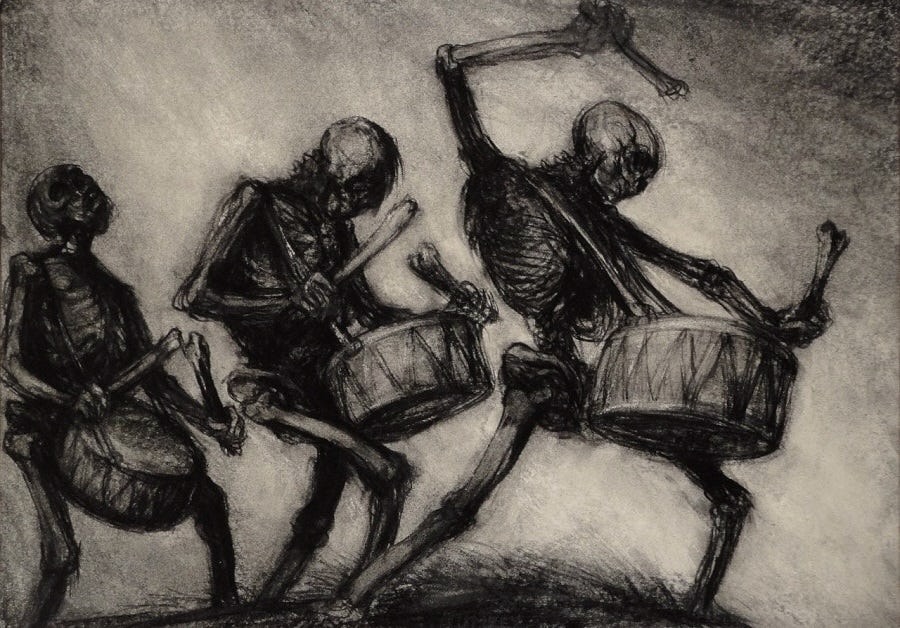
The Dance of Love and Death: The Inseparability of the Erotic and the Macabre in Carlos Fuentes
Academic Thesis
ABSTRACT
Anglophone literary criticism frequently confines Latin American literature within reductive postcolonial paradigms, privileging historical and sociopolitical readings over philosophical and psychoanalytic inquiry. This prevailing framework often reduces the essence of Latin American literary production to its colonial legacies, thereby eclipsing its engagement with metaphysical, existential, and ontological themes. Yet, the hallmark features of Latin American literature—such as its experimental narrative forms and seamless interweaving of the fantastic and the real—demand a more nuanced critical lens. By foregrounding philosophical and psychoanalytic approaches, this thesis reclaims Carlos Fuentes, a seminal figure of the Latin American Boom, as a thinker whose works probe the fundamental mysteries of existence, despite his infrequent recognition as a philosopher in his own right.
Fuentes’ oeuvre enacts an striking symbiosis of Eros and Thanatos – the Freudian drives of life and death—articulating an interplay between the erotic and the macabre largely overlooked in Anglophone scholarship. His narratives do not merely juxtapose sex and death; rather, they reveal these forces as inextricably entwined, dual expressions of the same ontological impulse. Death haunts Fuentes’ fictional landscapes, casting its spectral shadow over erotic desire, while the erotic itself bears the imprint of mortality, destruction, and sadistic impulse. This study examines how Fuentes synthesizes these oppositional yet complementary forces, transmuting death into an erotically charged phenomenon and love into a spectral, macabre transcendence. Drawing on Freudian psychoanalysis, the dialectics of creation and destruction, and Indigenous Mesoamerican cosmology, this thesis situates Fuentes within a broader intellectual tradition that interrogates the liminal spaces between unity and dissolution, eros and annihilation.
Through close readings of The Death of Artemio Cruz, Aura, and Inez, this thesis elucidates Fuentes’ transformation of love into an existential act of self-abnegation and metaphysical transcendence. In this vision, love mirrors death: the surrender of self in erotic union parallels the final dissolution of the self in the face of mortality. By reconfiguring love and death as cosmic, metaphysical phenomena, Fuentes compels readers to confront their inseparability as primal forces shaping human identity and experience. This study thus repositions Fuentes not merely as a Latin American literary icon but as a philosopher of the human condition, whose explorations of the erotic and the macabre, the sacred and the profane, illuminate the interconnectedness of all phenomena. Within Fuentes’ imaginative universe, love and death emerge as seductive yet sinister forces, locked in an eternal dance–each ceaselessly entwining with the other to form a sublime, unified continuum of transcendence.

Atziluth, Tzaphiron, Tassili n’Ajjer
Short Story
“Atziluth, Tzaphiron, Tassili n’Ajjer” is a short story that blends philosophical, speculative, and historical fiction, psychological horror, and magical realism. In 1977, a German archaeologist uncovers a lost journal in the Algerian desert belonging to Ariadne Mornève, a brilliant French linguist who disappeared in 1927 while searching for a primordial, pre-Babelian language. As her entries spiral into dreams, symbols, and madness, the story explores the limits of language, memory, and reality—tracing a haunting linguistic enigma across time, myth, and the collective human (un)consciousness.
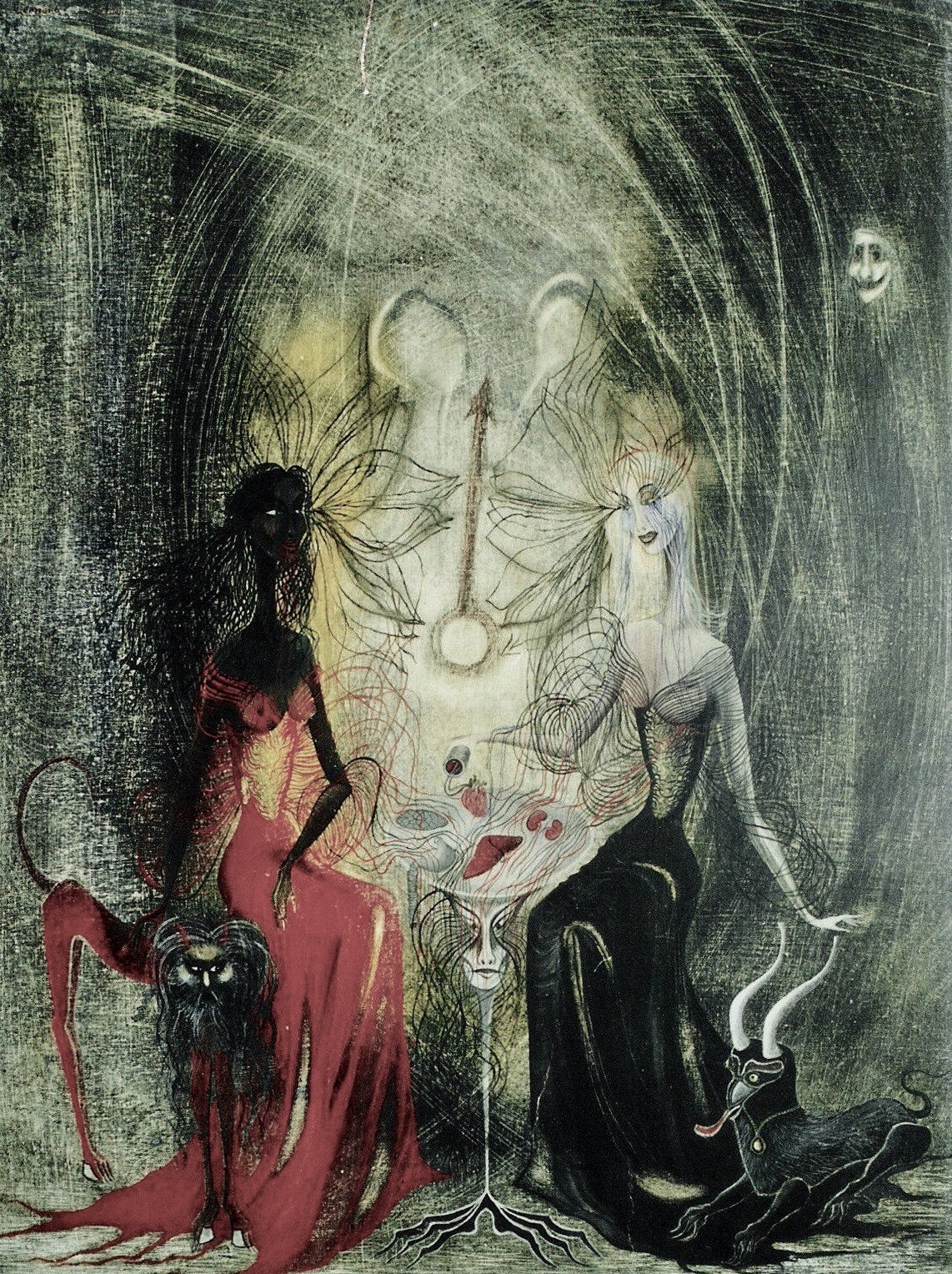
The Virgin Ceiba
Short Story
Set in sixteenth-century Castile and New Spain, “The Virgin Ceiba” traces the mystical trajectory of Sor Anacleta de la Luz Carmesí, a Castilian novice whose visions of the Virgin Mary culminate in ecstatic revelations of God embodied in a ceiba tree in the jungles of the Sierra Norte de Puebla, Mexico. In the New World she encounters Leonor Xóchitl, and together they enter a clandestine, transgressive communion that entwines mysticism, eros, and the natural world—articulating a feral theology in which faith and desire converge to reimagine the sacred beyond ecclesiastical bounds.
 Ava Linda Feliz-Sutter