
Ava Linda Feliz-Sutter
Writer, student, artist, teacher, musician, and environmentalist. Drawn to all that is strange, surreal, sacred, and transcendent.
About

Ava Linda Feliz-Sutter is a writer, artist, and scholar with an Honors B.A. in Romance Languages & Literatures, concentrating in Spanish and French, and a minor in Religion from Wesleyan University, where she is currently completing her thesis. Her academic and artistic pursuits center on language, literature, philosophy, and spiritual-ecological thought across the Americas.
In both her scholarship and art, Ava Linda is drawn to ways of perceiving, apprehending, and inhabiting the world that resist rigid binaries, turning instead toward its irreducible complexity and inextricable entanglements. Her fiction often brings together environmental and historical fiction, surrealism, magical realism, and the gothic. Across her work, she is guided by a boundless love for the earth, a growing concern over humanity’s estrangement from other beings, and a fear that this estrangement may harden into severance. She writes, paints, studies, learns, and teaches from the conviction that true change must first take place in the mind before it can be realized in the world.
Alongside her artistic and academic pursuits, Ava Linda has spent several years teaching, tutoring, and mentoring students across a range of ages, backgrounds, and learning environments, both within her local community and beyond. She has also worked with Indigenous advocacy groups and human and land rights organizations, whose efforts are often inseparable from ecological and environmental struggle. Following her recent undergraduate graduation, she relocated to Oregon, where she hopes to devote more of her time to writing while becoming involved in environmental justice, cultural preservation, and ecological stewardship in the Pacific Northwest.

Research Interests
Primary Fields of Study: Comparative Literature; Latin American Literary and Cultural Studies; Literary Theory and Criticism; Philosophy (Metaphysics; Ontology; Phenomenology); Philosophy of Language; Philosophy of Religion; Religious Studies; Indigenous Studies (Mesoamerican; Andean; Amazonian); Indigenous Thought and Culture; Magical Realism; Fantastic Literature; Surrealism; Linguistics (Uto-Aztecan, Mayan, Quechuan); Linguistic Anthropology; Mysticism; Esoteric and Occult Traditions; Anthropology of Religion; Environmental Humanities.
Secondary Fields of Study: Western Esotericism; Environmental Phenomenology; Sociolinguistics; Psycholinguistics; Language Revitalization; Nahuatl; Psychoanalytic Theory (Freudian and Jungian); Myth Studies; Gothic Literature; Semiotics; Hermeneutics.
Key Authors, Artists, Thinkers, and Scholars
Authors, Writers, and Artists: Carlos Fuentes; Elena Garro; Juan Rulfo; José María Arguedas; Miguel Ángel Asturias; João Guimarães Rosa; Clarice Lispector; Elena Poniatowska; Jorge Luis Borges; Horacio Quiroga; Leonora Carrington; Remedios Varo; Meister Eckhart; Emily Brontë; Charlotte Brontë.
Theorists, Thinkers, and Scholars: Rodolfo Kusch; Miguel León-Portilla; James Maffie; Marisol de la Cadena; Eduardo Kohn; Walter Benjamin; Georges Bataille; Jacques Derrida; Julia Kristeva; Hélène Cixous; Luce Irigaray; Sigmund Freud; Carl Gustav Jung.
“Tú, que me lees, ¿estás seguro de entender mi lenguaje?
— Jorge Luis Borges, “La Biblioteca de Babel”
Academic & Creative Work

Academic Work

Literary Work
Visual Art

Posts & Reflections
Latest Publications


Books Fantasy Feminism Fiction Forest French Gothic Gothic Fiction Indigenous Cosmology Indigenous Epistemologies Language Linguistics Literary Fiction Literature Love Magical Realism Magical Realism & the Marvelous Mesoamerica Myth Mythology Nahuatl Nature Nature Writing Philosophical Fiction Poetry Romance Short Story Spanish Storytelling writing
Selected Writings
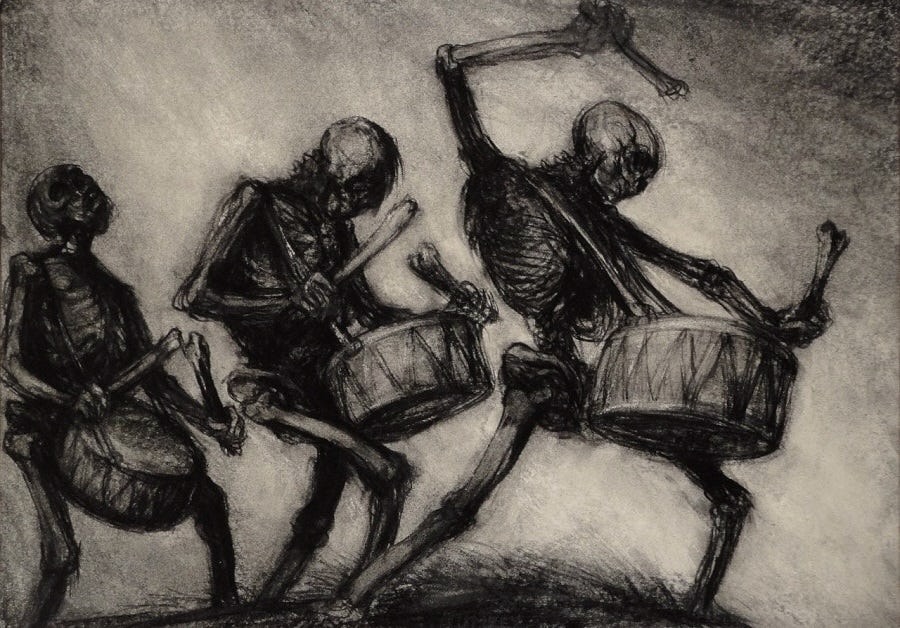
“The Dance of Love and Death”: The Inseparability of the Erotic and the Macabre in Carlos Fuentes
Academic Thesis
ABSTRACT
Anglophone literary criticism has long approached Latin American literature through a predominantly postcolonial lens, privileging historical and sociopolitical interpretation while only intermittently according it the philosophical seriousness routinely granted to European literary traditions. This critical tendency often risks reducing Latin American literary production to the aftereffects of colonial history, thereby obscuring its sustained engagement with metaphysical, existential, and ontological inquiry. Yet the defining characteristics of Latin American literature—its formal experimentation and its seamless interweaving of the fantastic and the real—call for a more capacious critical framework. By foregrounding philosophical and psychoanalytic approaches, this thesis reclaims Carlos Fuentes as a thinker whose work rigorously interrogates the fundamental conditions of human existence, despite his relative marginalization as a philosophical interlocutor within Anglophone criticism. It argues for the necessity of reading Latin American literature not only as historically situated, but as philosophically and psychoanalytically generative in its own right.
This study contends that Fuentes’s oeuvre is structured by an intimate and persistent interrelation between the erotic and the macabre—an enduring preoccupation with sex and death that culminates in their convergence as inseparable, transcendental forces. In Fuentes’s narratives, sex and death are not merely juxtaposed but revealed as dual expressions of the same ontological impulse. The macabre functions as the shadow of the erotic, suggesting that desire is inextricable from mortality, while eroticism itself bears the imprint of destruction, pain, and excess. This dynamic closely parallels the Freudian relation between Eros and Thanatos, wherein the life drive and the death drive collide, converge, and at times coalesce. For Fuentes, death is erotic, and sex is irreducibly marked by the logic of finitude.
Through close readings of The Death of Artemio Cruz, Aura, and Inez, this thesis demonstrates how Fuentes reconceptualizes love as an act of metaphysical self-abnegation and transcendence. Erotic union mirrors death: to lose oneself in another through love parallels the dissolution of the self in mortality. By reconfiguring sex and death as philosophical and cosmological phenomena rather than merely thematic motifs, this study repositions Fuentes as a thinker of the human condition. It argues that within his literary universe, love and death are not opposites but interdependent, seductive, and often unsettling forces locked in an ongoing relation—each ceaselessly entwined with the other to form a single continuum of transcendence. Through the interpenetration of the erotic and the macabre, Fuentes ultimately suggests that to love is already to die, and that dying itself constitutes an erotic, transcendent act.

Atziluth, Tzaphiron, Tassili n’Ajjer
Short Story
“Atziluth, Tzaphiron, Tassili n’Ajjer” is a short story that blends philosophical, speculative, and historical fiction, psychological horror, and magical realism. In 1977, a German archaeologist uncovers a lost journal in the Algerian desert belonging to Ariadne Mornève, a brilliant French linguist who disappeared in 1927 while searching for a primordial, pre-Babelian language. As her entries spiral into dreams, symbols, and madness, the story explores the limits of language, memory, and reality—tracing a haunting linguistic enigma across time, myth, and the collective human (un)consciousness.
The Virgin Ceiba
Short Story
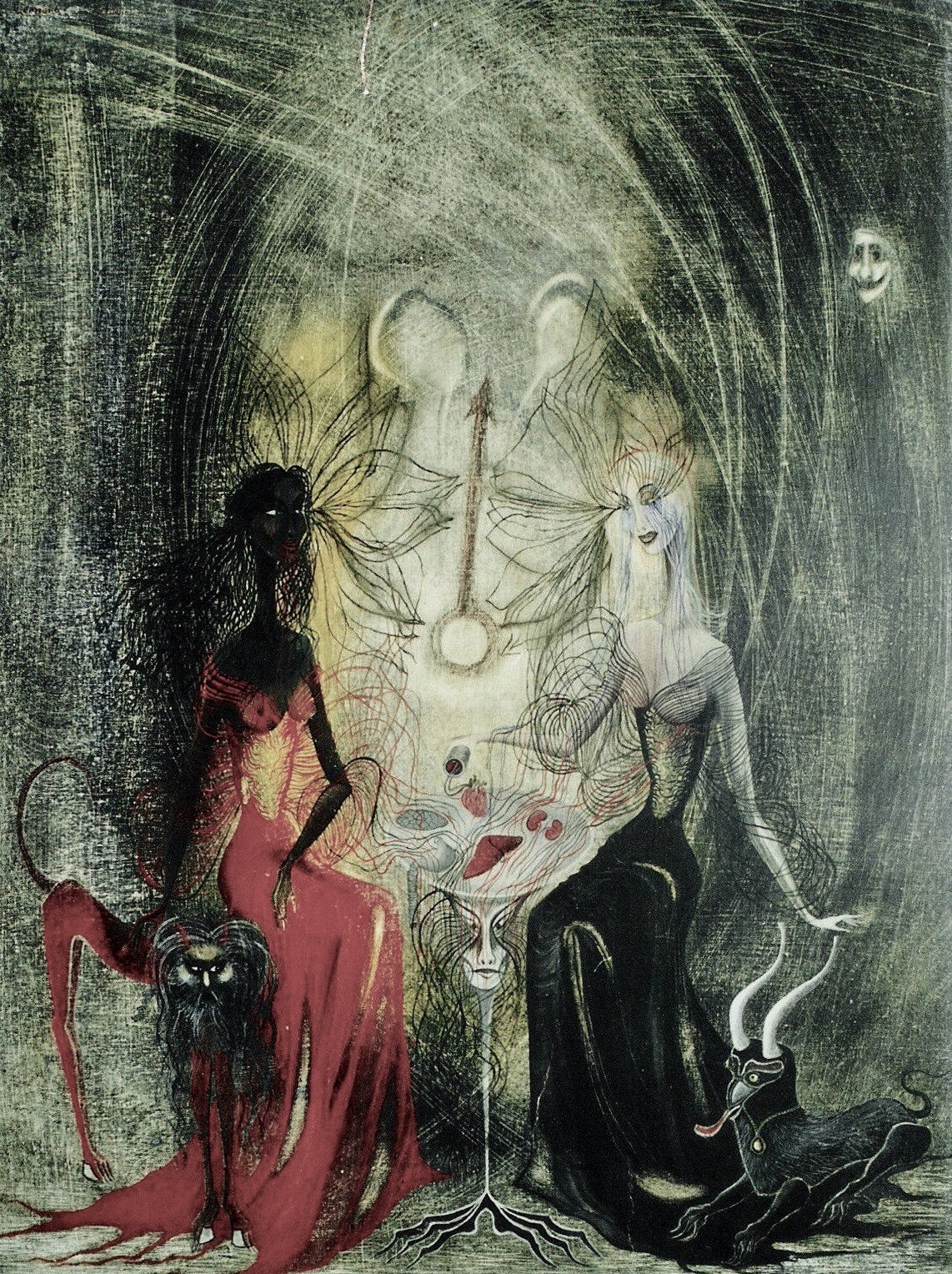
Set in sixteenth-century Castile and New Spain, “The Virgin Ceiba” traces the mystical trajectory of Sor Anacleta de la Luz Carmesí, a Castilian novice whose visions of the Virgin Mary culminate in ecstatic revelations of God embodied in a ceiba tree in the jungles of the Sierra Norte de Puebla, Mexico. In the New World she encounters Leonor Xóchitl, and together they enter a clandestine, transgressive communion that entwines mysticism, eros, and the natural world—articulating a feral theology in which faith and desire converge to reimagine the sacred beyond ecclesiastical bounds.
 Ava Linda Feliz-Sutter